

What Are the Key Gas vs Electric Tankless Water Heater Differences?
Understanding the gas vs electric tankless water heater differences is the first step to choosing the right system for your Houston home. Here’s a quick side-by-side breakdown:
| Feature | Gas Tankless | Electric Tankless |
|---|---|---|
| Flow Rate | 5–10+ GPM | 2–5 GPM |
| Thermal Efficiency | 80–96% UEF | 98–99% UEF |
| Best For | Large homes, high demand | Small homes, point-of-use |
| Venting Required | Yes | No |
| Electrical Upgrade Needed | Rarely | Often |
| Cold Climate Performance | Excellent | Limited |
| Lifespan | 15–20+ years | 15–20+ years |
Your water heater quietly handles about 18% of your home’s total energy use — every single day. When it finally gives out, or when you’re ready to upgrade, the choice between gas and electric tankless can feel overwhelming.
Both types heat water on demand, meaning no tank sits idle burning energy to keep 50 gallons warm while your family is at work or school. That alone makes tankless units significantly more efficient than traditional storage tank heaters — up to 24–34% more efficient for households using 41 gallons or less per day, according to the U.S. Department of Energy.
But gas and electric tankless systems work in very different ways, and the wrong choice for your home’s size, infrastructure, and daily demand can mean cold showers, high utility bills, or costly installation surprises down the road.
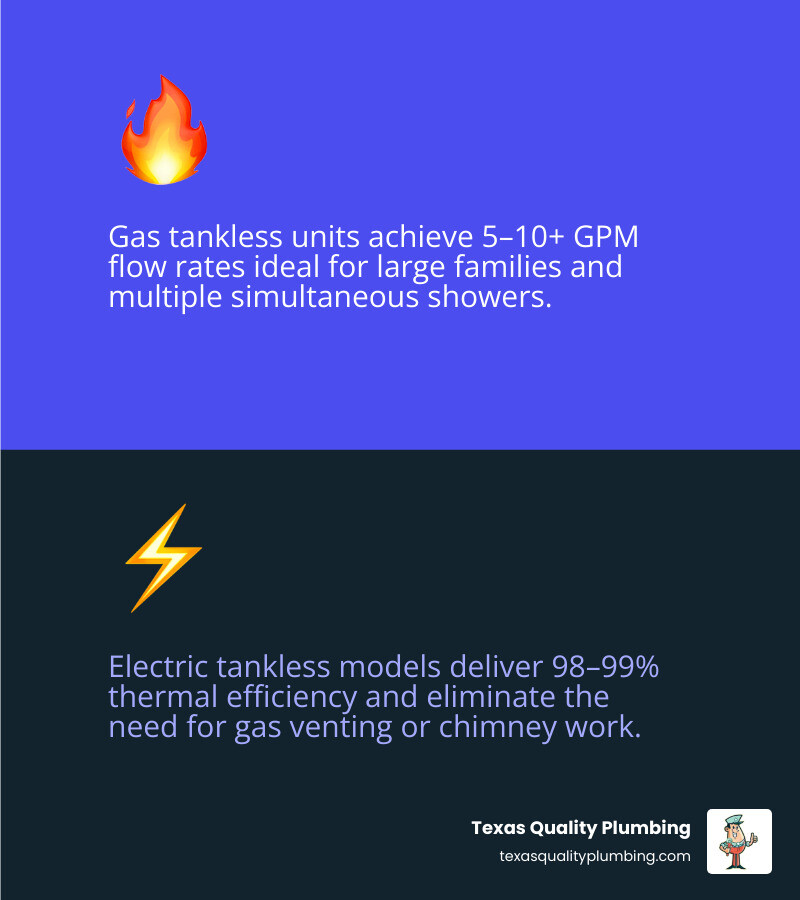
Key Gas vs Electric Tankless Water Heater Differences in Performance
When we look at how these units actually function, the core gas vs electric tankless water heater differences start with the heating source. A gas unit uses a powerful burner and a heat exchanger to flash-heat water, while an electric unit uses high-voltage resistance elements.

In Houston, understanding Tankless Water Heater Basics Houston is essential because our local environment dictates how hard these machines have to work. Electric models are incredibly efficient at the point of use, often reaching 98% to 99% thermal efficiency because there is no heat lost through a chimney or vent. Gas models, however, range from 80% to 96% Uniform Energy Factor (UEF). While that number looks lower, gas units often have a higher “site efficiency” in terms of how much raw power they can put into the water at once.
Gas vs Electric Tankless Water Heater Differences in Flow Rate
Flow rate is measured in Gallons Per Minute (GPM), and this is where gas and electric units diverge sharply. Gas tankless heaters are the heavy hitters, typically delivering 5 to 10 GPM (and sometimes up to 12 GPM). This makes them ideal for larger Houston households where someone might be taking a shower in the master bath while the dishwasher is running and a load of laundry is in the wash.
Electric models generally range from 2 to 5 GPM. While they can reach up to 8 GPM in very warm climates, they often struggle with Tankless Water Heater Size Problems if you try to run multiple fixtures at once. If you have a large family in a four-bedroom home in Cypress or Pearland, an electric unit might not keep up with the simultaneous demand, leading to the dreaded “cold water sandwich” or a sudden drop in pressure.
Gas vs Electric Tankless Water Heater Differences in Cold Weather
You might think Houston doesn’t get “cold,” but our groundwater temperature can drop significantly during winter months. This affects the “temperature rise”—the difference between the cold water coming into your home and the hot water coming out of your tap.
Gas units excel here because they can ramp up their BTU (British Thermal Unit) output almost instantly to overcome cold inlet temperatures. Electric units have a “hard ceiling” on how much power they can draw from your electrical panel. During a rare Houston freeze, an electric unit might only be able to provide a lukewarm trickle, whereas a gas unit maintains its performance. For more on this, check out our guide on Tankless Water Heaters Winter Performance.
Infrastructure and Installation Requirements for Houston Homes
Before you fall in love with a specific model, we have to look at what your home is actually built for. The gas vs electric tankless water heater differences in installation can be the deciding factor for many homeowners in areas like Memorial or The Woodlands.
- Venting: Gas units require specialized venting to safely exhaust combustion gases. This often involves stainless steel or PVC venting, depending on whether the unit is condensing or non-condensing. We often see specific requirements for Tankless Water Heater Venting in Pasadena and other local municipalities.
- Gas Lines: A tankless gas heater needs a lot of fuel all at once. This often requires upgrading your gas line from a standard 1/2-inch pipe to a 3/4-inch or 1-inch pipe to ensure the unit doesn’t “starve” for fuel.
- Electrical Service: An Electric Water Heater Install might seem simpler because there’s no venting, but it often requires a massive amount of power. Many whole-home electric tankless units require two, three, or even four dedicated 40-amp or 60-amp double-pole breakers. If your home in Sugar Land or Katy has an older 100-amp or 150-amp panel, you might need a full electrical panel upgrade to support the heater.
Efficiency, Maintenance, and Long-Term Reliability
Both gas and electric tankless units are designed to last 20 years or more—nearly double the lifespan of a traditional tank. However, their environmental impact and day-to-day efficiency differ.
| Specification | Gas Tankless | Electric Tankless |
|---|---|---|
| Annual Energy Savings | Higher (due to lower gas prices) | Lower (electricity is often pricier) |
| Greenhouse Gas Emissions | Direct emissions from combustion | Zero on-site (depends on grid) |
| Carbon Footprint | Moderate | Low (if using renewables) |
| Efficiency Rating | 0.81 – 0.96 UEF | 0.98 – 0.99 UEF |
While electric units have a higher efficiency rating, gas is often the more cost-effective choice in Texas because natural gas prices have historically remained more stable than electricity. From an environmental standpoint, electric units produce no on-site emissions, making them a popular choice for “green” builds, especially when paired with solar panels. You can read more about the Energy Savings Tankless Water Heaters to see how these units pay for themselves over time.
Maintenance Needs for Houston’s Water Quality
Houston is known for many things, but “soft water” isn’t one of them. Whether you are in Humble or Friendswood, hard water is a reality. Mineral buildup—specifically calcium and magnesium—can settle on the heat exchanger of your tankless unit.
If you don’t address Scaling Issues Tankless Water Heaters, the unit will have to work harder to heat the water, eventually leading to component failure. We recommend an annual flush and descaling for both types of units, though gas units also require a quick check of the burner and venting system. Following a Tankless Water Heater Maintenance Guide is the best way to ensure your 20-year investment actually lasts 20 years.
Frequently Asked Questions about Tankless Water Heaters
Which type is better for a large family in Houston?
For most large families in the Greater Houston area, a gas tankless water heater is the superior choice. The higher GPM (Gallons Per Minute) flow rate allows for multiple simultaneous uses—like two showers and a washing machine running at once—without a drop in water temperature.
Do tankless water heaters work during a power outage?
Technically, no. Electric units obviously won’t work without power. Gas units also require electricity to power the digital control board and the electronic ignition. However, because gas units use very little electricity, they can often be powered by a small battery backup or a portable generator during a storm.
How long do these units typically last with proper care?
With regular annual maintenance and descaling, both gas and electric tankless water heaters are expected to last 20 years or more. This is a significant upgrade over traditional tank heaters, which usually only last 10 to 15 years before they begin to leak or lose efficiency.
Who in Houston specializes in professional tankless water heater installation?
Choosing between gas and electric is a big decision, but you don’t have to make it alone. At Texas Quality Plumbing, we specialize in helping Houston homeowners navigate the gas vs electric tankless water heater differences to find the perfect fit for their lifestyle.
Whether you’re in Porter, Atascocita, or West University Place, our licensed plumbers provide expert Tankless Water Heaters services. From evaluating your current gas lines to checking your electrical panel’s capacity, we ensure your new system is installed safely and efficiently.
Ready to upgrade your home’s comfort? Get a Water Heater Quote today or explore our full range of Water Heaters services. We are committed to providing the Greater Houston area with reliable, high-quality plumbing solutions that keep the hot water flowing for years to come.