

Is Gas or Electric Better for Your Texas Home? Here’s What Houston Homeowners Need to Know
Choosing between gas and electric for your Texas home is one of the most practical decisions you’ll make as a homeowner — and the right answer depends on your existing infrastructure, how you use hot water, and what’s available in your neighborhood.
Here’s a quick breakdown to help you decide:
| Factor | Gas | Electric |
|---|---|---|
| Upfront cost | Higher (gas line, venting) | Lower (no gas line needed) |
| Operating cost | Generally lower per BTU | Higher per BTU at current TX rates |
| Safety | CO risk; requires venting | No combustion; no CO risk |
| Best for | Larger homes, high hot water demand | Smaller homes, all-electric setups |
| Infrastructure needed | Gas line access | Adequate electrical panel capacity |
| Heat pump option | No | Yes — most efficient choice |
For most Houston homeowners, gas wins on operating cost if you already have a gas line. If your home is all-electric or you’re building new, a heat pump water heater or electric tankless unit is often the smarter long-term play.
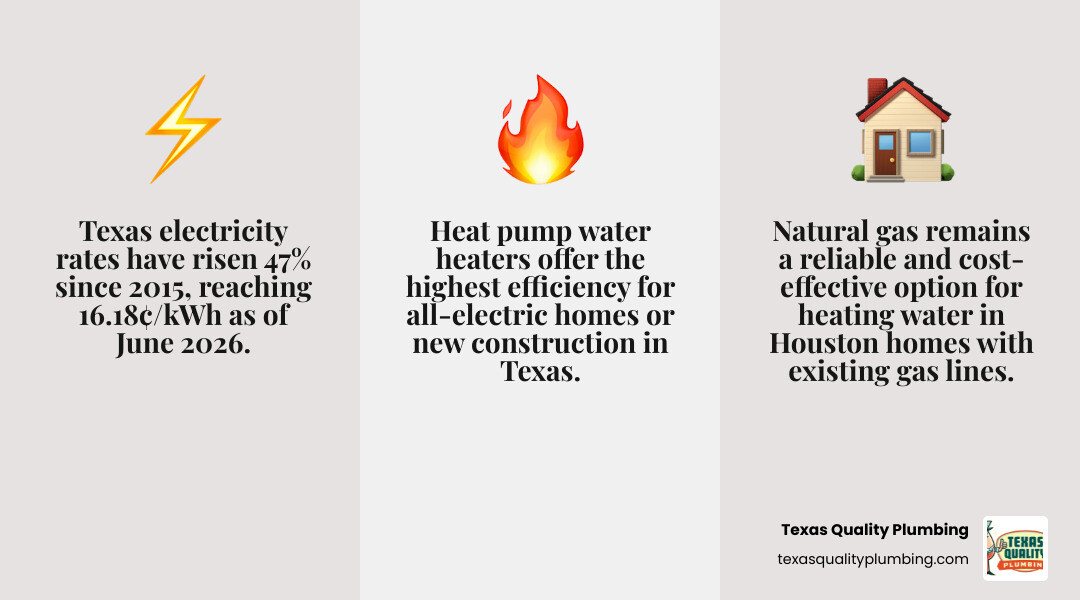
Texas runs on a unique deregulated energy market, and electricity rates have climbed significantly in recent years — up 47% since 2015, reaching an average of 16.18¢/kWh as of June 2026. That makes fuel source decisions more consequential than ever. At the same time, natural gas remains a reliable, cost-effective option for heating water and powering home appliances throughout the Houston area.
Whether you’re replacing an aging water heater, remodeling your home, or just trying to get ahead of rising utility bills, understanding the tradeoffs between gas and electric systems will save you money and headaches down the road.
Key Factors in Choosing Between Gas and Electric for Your Texas Home

When evaluating options for your home in communities like Katy, Spring, or Sugar Land, the decision-making process goes far beyond a simple comparison of monthly bills. Several critical factors dictate whether a gas or electric system is the most practical choice for your specific property.
First and foremost is existing infrastructure. If your home was built with only electrical connections, transitioning to natural gas is not as simple as buying a new appliance. Bringing a natural gas line from the street to your home, routing it through your walls, and establishing proper ventilation requires significant coordination and professional pipe installation. Conversely, if your home already has active natural gas lines, replacing an old gas unit with a modern, high-efficiency gas appliance is highly straightforward and maximizes your pre-existing setup.
Another major consideration is utility availability. While natural gas is widely available in established urban and suburban neighborhoods across Houston, Pasadena, and Pearland, some newer master-planned communities or rural areas around Porter and Huffman are designed as strictly all-electric subdivisions. In these neighborhoods, deed restrictions or a lack of municipal gas mains make electric systems your default choice.
Finally, you must consider long-term home value and buyer preferences. Statistical data indicates that 8 out of 10 homebuyers across the country prefer homes equipped with natural gas appliances. Furthermore, homes with natural gas connections tend to sell faster and can average a 6% higher resale value.
For a complete breakdown of how these power sources operate in modern appliances, check out our comprehensive guide on Gas vs Electric Tankless Water Heater 101.
Comparing Water Heating Systems: Gas vs. Electric
Water heaters are the second-largest energy consumers in the typical Texas household, trailing only your air conditioning system. Because of this, selecting the right fuel source for your water heater has a massive impact on your monthly utility bills.
When comparing traditional tank-style water heaters, gas and electric models perform very differently. Gas water heaters rely on a burner at the bottom of the tank to heat the water, venting combustion gases through a flue. Electric water heaters use submerged electrical resistance elements to transfer heat directly to the water.
While electric models boast higher energy factor ratings on paper (often between 0.90 and 0.95, compared to 0.58 to 0.62 for gas tanks), this doesn’t automatically translate to lower operating costs. Because natural gas is highly cost-effective per BTU compared to electricity, gas water heaters are generally much cheaper to operate month-to-month. In fact, households using natural gas for major energy needs save an average of $879 every year compared to those relying entirely on electricity.
Additionally, gas water heaters feature a much faster recovery rate. A standard gas tank can recover 40 to 50 gallons of hot water per hour, whereas an electric tank typically manages only 20 to 25 gallons. This makes gas systems highly reliable for larger families in areas like Atascocita and League City, where back-to-back showers can quickly drain a tank.
However, upgrading to tankless technology represents a major leap forward for both fuel types, eliminating standby energy loss entirely. You can explore these advantages in detail by reading about the Benefits of Tankless Water Heaters.
| Performance Feature | Gas Tankless | Electric Tankless |
|---|---|---|
| Recovery Rate / Flow Rate | High (unlimited continuous flow) | Moderate (limited by electrical draw) |
| Energy Factor Rating | 0.95+ | 0.99+ |
| Standby Energy Loss | None | None |
| Typical Lifespan | 20+ years | 20+ years |
| Venting Required | Yes (PVC or concentric) | No |
Choosing Between Gas and Electric for Your Texas Home: Tankless Water Heaters
For those interested in upgrading to on-demand hot water, the debate between gas and electric tankless systems is highly dependent on your home’s utility capacities.
A gas tankless water heater requires a substantial volume of fuel to fire its high-output burners instantly. This means your existing gas line capacity must be evaluated; older homes in historic Houston neighborhoods may require a gas line upgrade to support the increased BTU demand.
On the other hand, an electric tankless water heater does not require gas lines or venting, but it demands an immense amount of electrical power. These units typically require multiple dedicated 240-volt circuits and can draw up to 120 amps or more. If your home in Spring or Cypress has a standard 100-amp or 150-amp electrical panel, you will likely need a complete electrical panel upgrade to support an electric tankless system.
To help navigate these infrastructure requirements, we have compiled Everything Texas Homeowners Need to Know About Going Tankless.
Choosing Between Gas and Electric for Your Texas Home: Operational Efficiency
Operational efficiency is where modern engineering truly shines. Traditional tank systems suffer from standby loss — the constant cooling and reheating of water sitting in the tank while you are asleep or at work.
Tankless systems solve this problem by heating water only when a tap is turned on. Because they operate on demand, they achieve remarkable thermal efficiency. Gas tankless units utilize condensing technology to capture heat from exhaust gases, pushing efficiency levels up to 95%. Electric tankless units operate at nearly 100% efficiency, as almost no heat is lost during the transfer process.
By eliminating standby losses and maximizing thermal transfer, switching to an on-demand system yields substantial long-term utility savings. Discover how much you can trim from your monthly bills by reading about Energy Savings Tankless Water Heaters.
Infrastructure, Safety, and Installation Requirements
Installing a new water heating system requires strict adherence to local building codes and safety regulations. Each fuel type presents unique installation challenges that must be handled by licensed professionals.
For gas-powered appliances, venting requirements are paramount. Combustion produces carbon monoxide (CO), an odorless, colorless gas that must be safely exhausted outside your home. Modern condensing gas units use specialized PVC venting to safely direct exhaust through an exterior wall or roof, while older non-condensing units require metal flues. Ensuring proper venting is critical for indoor air quality and family safety. For a real-world look at how these standards are applied locally, read our guide on Tankless Water Heater Venting in Pasadena.
Electric installations, while free of carbon monoxide risks, carry their own safety considerations. Working with high-voltage electricity requires precise circuit loading and proper grounding to prevent fire risks or electrical shocks. If your home’s electrical panel is already near capacity, adding an electric water heater without upgrading the panel can lead to overloaded circuits and frequent breaker trips.
Regardless of the system you select, proper installation protects your investment, keeps your household safe, and ensures your system operates at peak performance for years to come.
Maintenance and Lifespan of Texas Home Utilities
To get the most out of your utility investments, regular preventative maintenance is non-negotiable. This is particularly true in the Greater Houston area, where water quality heavily influences appliance longevity.
Houston’s water supply contains varying levels of calcium carbonate, commonly known as hard water. As water is heated, this calcium precipitates out of solution and forms a hard scale inside your water heater. In electric models, scale coats the heating elements, acting as an insulator and forcing the system to work harder to heat the water, which ultimately burns out the elements. In gas models, sediment settles at the bottom of the tank, creating a barrier between the burner and the water, which leads to overheating, tank metal fatigue, and premature tank failure.
To combat hard water damage, traditional tank heaters rely on a sacrificial anode rod to attract corrosive elements away from the tank walls. This rod must be inspected and replaced every few years. For tankless systems, annual system flushing with a food-grade descaling solution is essential to clear scale buildup from the narrow copper heat exchanger channels.
With proper care, the differences in appliance lifespans are substantial. While traditional tanks typically last 8 to 12 years, modern tankless units can easily serve your home for two decades or more.
To learn more about maximizing your system’s life, read about The Surprising Lifespan of Modern Tankless Water Heaters and follow our step-by-step Tankless Water Heater Maintenance Guide.
Frequently Asked Questions About Texas Home Utilities
Is gas or electric better for a Houston water heater?
For most homes in Houston, Pasadena, and surrounding communities, gas is the preferred option if you already have an active gas line. Gas systems offer faster recovery speeds, making them ideal for larger households with high hot water demands. However, if your neighborhood does not have gas infrastructure or you want to avoid venting modifications, an electric system is a highly reliable alternative. For a deeper dive into local considerations, read Tankless Water Heater Basics Houston Homeowners Should Know.
What are the venting requirements for gas water heaters in Texas?
Gas water heaters must be vented to the outdoors to safely exhaust combustion byproducts like carbon monoxide. Standard units use atmospheric venting through metal flues, while high-efficiency condensing units utilize power venting with PVC pipes routed through an exterior wall. Proper venting is strictly regulated by local building codes to protect indoor air quality and ensure household safety.
How does hard water affect gas vs. electric water heaters?
Hard water leads to calcium carbonate scale buildup in both systems. In electric water heaters, scale accumulates on the heating elements, reducing heat transfer and causing them to burn out. In gas water heaters, sediment builds up on the bottom of the tank or inside the heat exchanger, leading to localized overheating and efficiency loss. Regular flushing is required to prevent these issues; you can read more about troubleshooting these problems in our articles on Common Issues Tankless Water Heaters and Tankless Water Heater Error Codes.
Conclusion
Deciding between gas and electric for your home’s water heating and plumbing systems is a major step toward optimizing your household comfort and managing long-term utility expenses. Whether you are leaning toward the fast recovery of a gas system or the clean, vent-free operation of an electric unit, the key to a successful upgrade lies in professional sizing, code-compliant installation, and dedicated maintenance.
At Texas Quality Plumbing, we specialize in helping homeowners throughout Greater Houston — including Houston, Katy, Spring, Conroe, and Pearland — navigate these exact decisions. We pride ourselves on delivering quick, efficient service with guaranteed 24-hour appointments, exceptional professionalism, and exclusive perks like waived fees for our VIP plan members.
Ready to find the perfect water heating solution for your household? Explore our professional Water Heater Services in Houston or contact us today to schedule your consultation!